
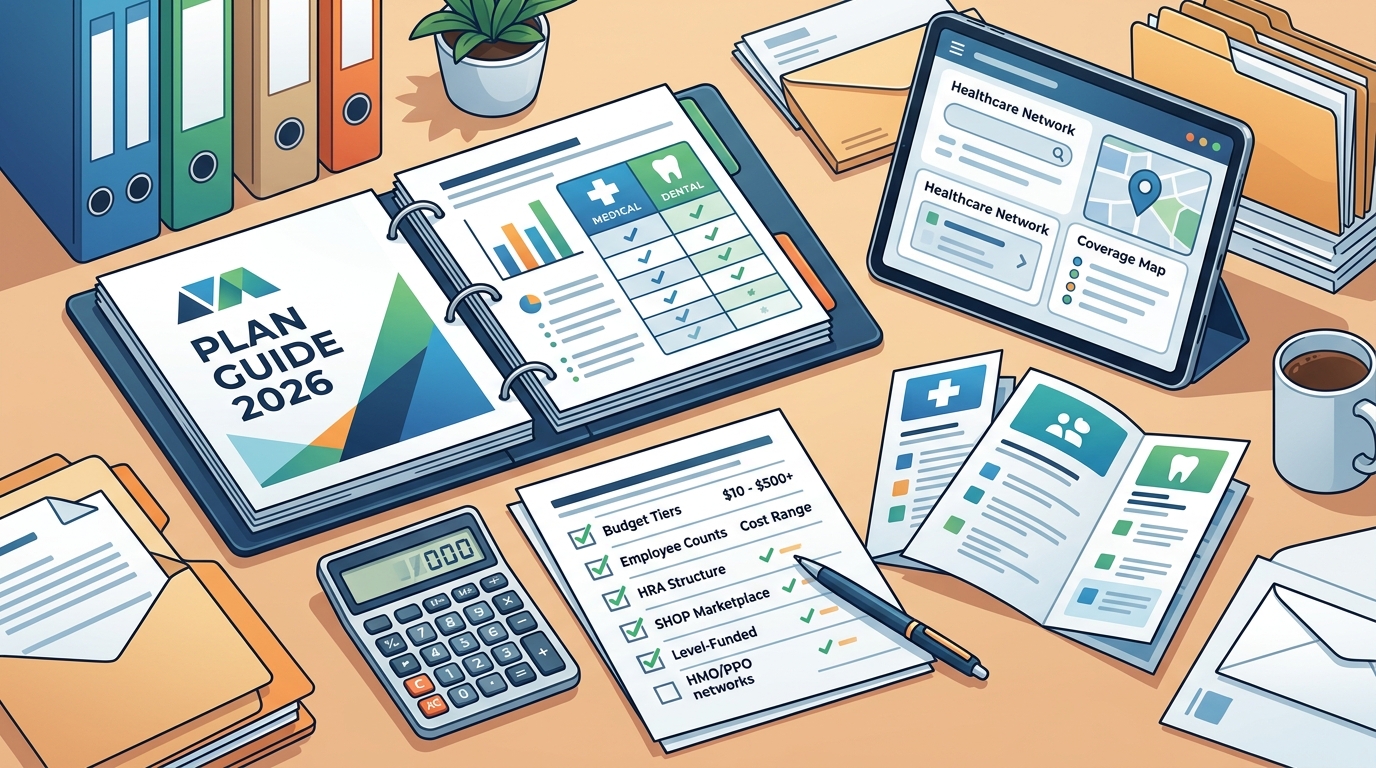
Small business owners often face a complex landscape of health and dental insurance options. The best choice depends on your budget, employee count, and risk tolerance. Generational Wealth Concepts helps business owners in Texas and Florida navigate these options. This guide covers cost ranges, HRAs, Shop Marketplace plans, Level-Funded plans, eligibility rules, and PPO/HMO structures to help you make an informed decision.
Dental and Vision Cost Ranges
Understanding Dental Coverage Tiers
Vision Insurance Basics
Health Reimbursement Arrangements
A Health Reimbursement Arrangement (HRA) is a tax-advantaged benefit that allows employers to reimburse employees for qualified medical expenses. HRAs are flexible because they can be designed to cover a wide range of expenses, from premiums to out-of-pocket costs. For small business owners, HRAs offer a way to provide health benefits without the administrative burden of managing a full group plan.
Types of HRAs
There are several types of HRAs, each with different rules. The Integrated HRA is used alongside a group health plan to reimburse for deductibles and copays. The Qualified Small Employer HRA (QSEHRA) is available to businesses with fewer than 50 employees. It allows employees to purchase individual health insurance and be reimbursed for premiums and out-of-pocket costs. The Individual Coverage HRA (ICHRA) is a newer option that allows employers to provide a fixed monthly allowance for employees to buy individual plans.
Tax Advantages of HRAs
HRAs are tax-free for both the employer and the employee. Contributions are not subject to payroll taxes, and reimbursements are not taxed as income. This makes HRAs a cost-effective way to provide health benefits. However, there are strict rules regarding how the funds can be used. For example, QSEHRA reimbursements cannot be used for tobacco products or over-the-counter medications without a prescription.
Shop Marketplace Options
The Shop Marketplace is a platform where small businesses can compare and purchase group health insurance plans. It is a centralized location that allows employers to see quotes from multiple carriers at once. This transparency helps business owners make informed decisions about coverage and cost. The Shop Marketplace is particularly useful for businesses with 1 to 50 employees.
How the Shop Marketplace Works
When you access the Shop Marketplace, you will provide basic information about your business, such as the number of employees and their locations. The platform will then display available plans from various insurance carriers. You can compare premiums, deductibles, and provider networks side by side. This process saves time and ensures that you are getting competitive pricing.
Benefits of Using the Shop Marketplace
One of the main benefits of the Shop Marketplace is the ability to access plans that might not be available through a traditional broker. It also provides a level of standardization in how plans are presented, making it easier to compare different options. For small business owners, this can be a valuable tool in navigating the complexities of group health insurance.
Level-Funded Plans
A Level-Funded plan is a type of health insurance that combines the predictability of a fixed premium with the flexibility of a self-funded plan. In a Level-Funded plan, the employer pays a fixed monthly premium to the insurance carrier. The carrier then pays the actual medical claims. If the claims are lower than the premium, the difference is refunded to the employer. If the claims are higher, the carrier absorbs the loss.
How Level-Funded Plans Differ from Traditional Plans
Traditional fully insured plans have fixed premiums that do not change based on claims. Level-Funded plans, on the other hand, have premiums that are adjusted based on the actual claims experience. This can result in lower costs for employers with healthy employees. However, it also means that the employer bears some of the risk associated with medical claims.
Who Should Consider Level-Funded Plans?
Level-Funded plans are best suited for businesses with a stable and healthy workforce. They are not recommended for businesses with a high number of employees with pre-existing conditions or chronic illnesses. Before choosing a Level-Funded plan, it is important to review your historical claims data to ensure that you are a good candidate.
Shop Marketplace Eligibility
Eligibility for the Shop Marketplace is determined by the number of full-time equivalent (FTE) employees. Generally, businesses with 1 to 50 FTE employees are eligible to purchase plans through the Shop Marketplace. This includes part-time employees, as long as they are counted as FTEs. The definition of an FTE is based on the number of hours worked per week.
Calculating FTEs
To calculate your FTE count, you need to add up the hours worked by all part-time employees and divide by 30. For example, if you have two part-time employees who each work 15 hours per week, they would count as one FTE. This calculation is important because it determines your eligibility for certain benefits and tax credits.
Impact of Eligibility on Plan Choice
Your FTE count also affects the types of plans you can purchase. For example, businesses with fewer than 50 employees may be eligible for the Small Business Health Care Tax Credit. This credit can offset up to 50% of the premiums paid for group health insurance. Understanding your eligibility is a critical step in choosing the right plan for your business.
Individual Coverage HRAs
An Individual Coverage HRA (ICHRA) is a type of HRA that allows employers to provide a fixed monthly allowance for employees to purchase individual health insurance plans. Unlike traditional group plans, ICHRAs do not require the employer to offer a specific group plan. Instead, the employer provides a set amount of money that the employee can use to buy any individual plan that meets certain requirements.
Flexibility of ICHRAs
ICHRA offers significant flexibility for both employers and employees. Employers can set different allowance amounts for different employee groups, such as full-time and part-time employees. Employees can choose the plan that best fits their needs and budget. This flexibility can be a major advantage for small businesses that want to offer health benefits without the complexity of managing a group plan.
Compliance Requirements for ICHRAs
While ICHRAs offer flexibility, they also come with strict compliance requirements. Employers must provide notice to employees about the ICHRA and the amount of the allowance. They must also ensure that the plans purchased by employees meet certain minimum essential coverage requirements. Failure to comply with these requirements can result in penalties.
Group PPO and HMO Plans
Group PPO (Preferred Provider Organization) and HMO (Health Maintenance Organization) plans are the two most common types of group health insurance. PPO plans offer more flexibility in choosing providers, while HMO plans are typically less expensive but require you to use in-network providers. The choice between a PPO and an HMO depends on your budget and the needs of your employees.
Comparing PPO and HMO Plans
| Provider Network | Large, flexible network | Smaller, restricted network |
| Out-of-Network Care | Covered at a higher cost | Generally not covered |
| Referrals | Not required | Required for specialists |
| Premiums | Higher | Lower |
| Deductibles | Higher | Lower |
Choosing the Right Plan Type
When choosing between a PPO and an HMO, consider the location of your employees and their preferred providers. If your employees are spread out geographically, a PPO might be a better fit. If your employees are concentrated in one area and are comfortable with a smaller network, an HMO might be more cost-effective. It is also important to consider the out-of-pocket costs, as PPOs typically have higher deductibles and copays.
Key Takeaways
- Dental and vision insurance are affordable benefits that can significantly improve employee satisfaction.
- HRAs offer a flexible and tax-advantaged way to provide health benefits to small business employees.
- The Shop Marketplace is a valuable tool for comparing group health insurance plans from multiple carriers.
- Level-Funded plans can save money for businesses with healthy employees but carry more risk.
- Eligibility for the Shop Marketplace is determined by your FTE count, which also affects tax credit eligibility.
- ICHRA provides flexibility for both employers and employees but requires strict compliance.
- PPO plans offer more provider flexibility, while HMO plans are typically less expensive.
- Choosing the right plan requires a careful analysis of your budget, employee needs, and risk tolerance.
Frequently Asked Questions
What is the best health insurance option for a small business with 5 employees?
For a small business with 5 employees, a QSEHRA or ICHRA might be the best option. These plans allow employees to purchase individual coverage and be reimbursed for premiums and out-of-pocket costs. This can be more cost-effective than a traditional group plan for very small businesses.
Can I offer dental and vision insurance without major medical insurance?
Yes, you can offer dental and vision insurance without major medical insurance. These benefits are often purchased separately and can be a valuable addition to your employee benefits package. They are also more affordable than major medical insurance.
What is the difference between a QSEHRA and an ICHRA?
A QSEHRA is available to businesses with fewer than 50 employees and allows employees to be reimbursed for premiums and out-of-pocket costs. An ICHRA is available to businesses of any size and allows employers to provide a fixed monthly allowance for employees to buy individual plans. The main difference is that ICHRAs allow for more flexibility in setting allowance amounts for different employee groups.
How do I calculate my FTE count for Shop Marketplace eligibility?
To calculate your FTE count, add up the hours worked by all part-time employees and divide by 30. For example, if you have two part-time employees who each work 15 hours per week, they would count as one FTE. This calculation is important because it determines your eligibility for certain benefits and tax credits.
Are Level-Funded plans a good option for small businesses?
Level-Funded plans can be a good option for small businesses with a stable and healthy workforce. They offer the predictability of a fixed premium with the potential for cost savings. However, they also carry more risk than traditional fully insured plans, so it is important to review your historical claims data before choosing this option.
What is the Small Business Health Care Tax Credit?
How do I choose between a PPO and an HMO plan?
Choosing between a PPO and an HMO depends on your budget and the needs of your employees. PPO plans offer more flexibility in choosing providers but have higher premiums and deductibles. HMO plans are typically less expensive but require you to use in-network providers and get referrals for specialists. Consider the location of your employees and their preferred providers when making this decision.
Can I use an HRA to reimburse for dental and vision expenses?
Yes, you can use an HRA to reimburse for dental and vision expenses, as long as they are qualified medical expenses. This can be a cost-effective way to provide these benefits to your employees. However, it is important to ensure that the HRA is structured in compliance with IRS rules.
Conclusion
Choosing the right health and dental insurance for your small business is a critical decision that impacts your budget and your employees' well-being. By understanding the various options available, from HRAs to Level-Funded plans, you can make an informed choice that fits your specific needs. Generational Wealth Concepts is here to help you navigate this complex landscape. We provide personalized guidance to ensure that your business is protected and your employees are well cared for. Explore our group health insurance services to learn more about how we can help your business thrive.